
Most setup happens on Chert’s side before you install. The seven steps below are the only customer-side work; total time is ~30 minutes plus one short pairing call with Chert during step 5.
Before the pairing call: Steps 1–4 should already be complete in your sandbox. The call covers step 5 (credential paste + verify) and step 6 (Slack channel install). Have on hand: a sandbox admin login, a test Lead with a real mobile number you control, and a workspace admin who can authorize the Slack OAuth install. Plan ~30 minutes.

What you do, what Chert does

StepOwnerTime
1. Install the package into your OrgYou5 min
2. Assign the Chert Messaging User Permission SetYou2 min
3. Add the chertConversation component to record pagesYou5 min
4. Add Quick Actions to Contact list viewsYou5 min
5. Configure the Chert_Tenant.Default Custom Metadata recordYou + Chert (paired)5 min
6. Connect the Slack channel for reply notificationsChert
7. (Optional) Wire a Flow handoff from your existing email sequencerYou10 min
Project-side setup, sequence templates, phone-line provisioning, and console configuration are handled by Chert before you install.

Before You Begin

RequirementHow to verify
Lightning Experience enabledFrom Setup, search Lightning Experience Transition Assistant. Status must be turned on for all users.
My Domain deployed to usersFrom Setup, search My Domain. Step 4 (Deploy to Users) must be complete.
API enabled on the Org’s editionEnterprise, Unlimited, Performance, and Developer Editions include API. Professional requires the API add-on. Essentials is not supported.
Installer is a System AdministratorThe user must hold Download AppExchange Packages, Customize Application, and Modify Metadata Through Metadata API Functions.
Outbound HTTPS to console.trychert.comIf your Org enforces an outbound IP allowlist, allow the Chert API host.
Salesforce CLI installed locallyRun sf --version. Must be 2.0.0 or later. Install via npm install -g @salesforce/cli.
Chert tenant credentialsConfirm with Chert that you have a tenant_slug, signing_secret, and ingest_token in hand before step 5.

The seven steps

1

Install the package into your Org

Chert is a Managed 2GP package. Install into a sandbox first, smoke-test, then install the same link into production.Install links (current version 0.1.0-2):Both links install the same package version. Sandbox uses test.salesforce.com; production uses login.salesforce.com.Install into the sandbox first:
  1. Click the sandbox link above. Salesforce prompts you to log in.
  2. Log in with a sandbox System Administrator account.
  3. On the Install Chert Messaging screen, choose Install for Admins Only. (You’ll grant end-user access via the Permission Set in step 2 — installing for All Users right away skips the Permission Set discipline.)
  4. Click Install. The install takes 2–5 minutes for a fresh org, longer if there are many existing automations.
  5. When the screen shows Installation Complete, you’re done with the sandbox install.
Install into production (after smoke-testing the sandbox install through steps 2–5):Repeat the same flow with the production link. The package version ID is identical — what changes is which Org you authenticate into.
Why “Install for Admins Only”? It defers user access until the Permission Set is assigned in step 2, so end users can never see the component before you’ve explicitly granted them access. This is the Salesforce-recommended pattern for ISV packages.
Verify the install:
  1. From Setup, search Installed Packages → confirm Chert Messaging appears with the expected version number.
  2. From Setup, search Setup Audit Trail → search for Chert_ to see the per-component install entries.
  3. From Setup → Object ManagerContactFields & Relationships → confirm these custom fields exist:
    • Chert_Phone_Confidence__c
    • Chert_Phone_Source__c
    • LinkedIn_URL__c
    • Chert_Last_Enriched_At__c
    • Chert_Enrichment_Status__c
If any of those are missing, the install completed partially. Re-run the install link; Salesforce will reconcile.Common install failures:
SymptomCauseFix
Install failed: FIELD_INTEGRITY_EXCEPTIONYour Org has a custom field with the same API name as one in the packageTell Chert which field conflicts; we can rename the package field and reissue the install link.
Install failed: API access requiredOrg edition lacks API access (e.g., Essentials, Professional without add-on)Confirm prerequisites in Before You Begin.
User Doesn't Have Access after installThe installer’s profile lacks Download AppExchange PackagesRe-run as a System Administrator.
Alternate path for source-tree deployments. If your team prefers deploying from source rather than a packaged install — for example, to integrate Chert into your existing CI/CD pipeline — Chert can provide the metadata source. Contact contact@trychert.com. The install-link path documented above is recommended for everyone else.
2

Assign the Chert Messaging User Permission Set

Salesforce best practice is Permission Set assignment, not Profile modification. The package contains no Profiles.
  1. From Setup, enter Permission Sets.
  2. Click Chert Messaging User.
  3. Click Manage AssignmentsAdd Assignments.
  4. Select the users who will send or review iMessages, then click Assign.
For larger rollouts, group Chert Messaging User into a Permission Set Group alongside any role-specific Permission Sets.What this grants: Read + Create on Chert_Message__c, Read + Edit on the Chert-prefixed Contact and Lead enrichment fields, Apex class access for the eight package classes, and Named Credential access to Chert_Endpoint. No View All Data, no Modify All Data. Full breakdown in Configuration.Verify:
  • From Setup → Permission SetsChert Messaging User, confirm the user count under Manage Assignments matches what you assigned.
  • Sign in as one of the assigned users (use the Login As option from Setup → Users) and confirm Step 3’s component appears.
For Orgs running Permission Set Groups: create a group named e.g. Chert Outbound that contains Chert Messaging User plus your existing Sales Rep Permission Set. Assign the group rather than the individual Permission Sets — easier to manage at scale and the audit trail is cleaner.
3

Add the chertConversation component to record pages

The package ships three pre-configured Lightning Record Pages. You activate them per Org, App, or record-type/profile combination.
  1. From Setup, enter Lightning App Builder.
  2. For each of the three shipped pages, click the page name then click Activation:
    • Lead Record Page Chert
    • Contact Record Page Chert
    • Account Record Page Chert (optional)
  3. Choose the activation scope:
    • Org Default — applies to every Lead/Contact/Account record across the Org.
    • App Default — scoped to one Lightning app (e.g., Sales Console).
    • Profile / Record Type — narrowest; assign only to specific profiles or record types.
  4. Click Save.
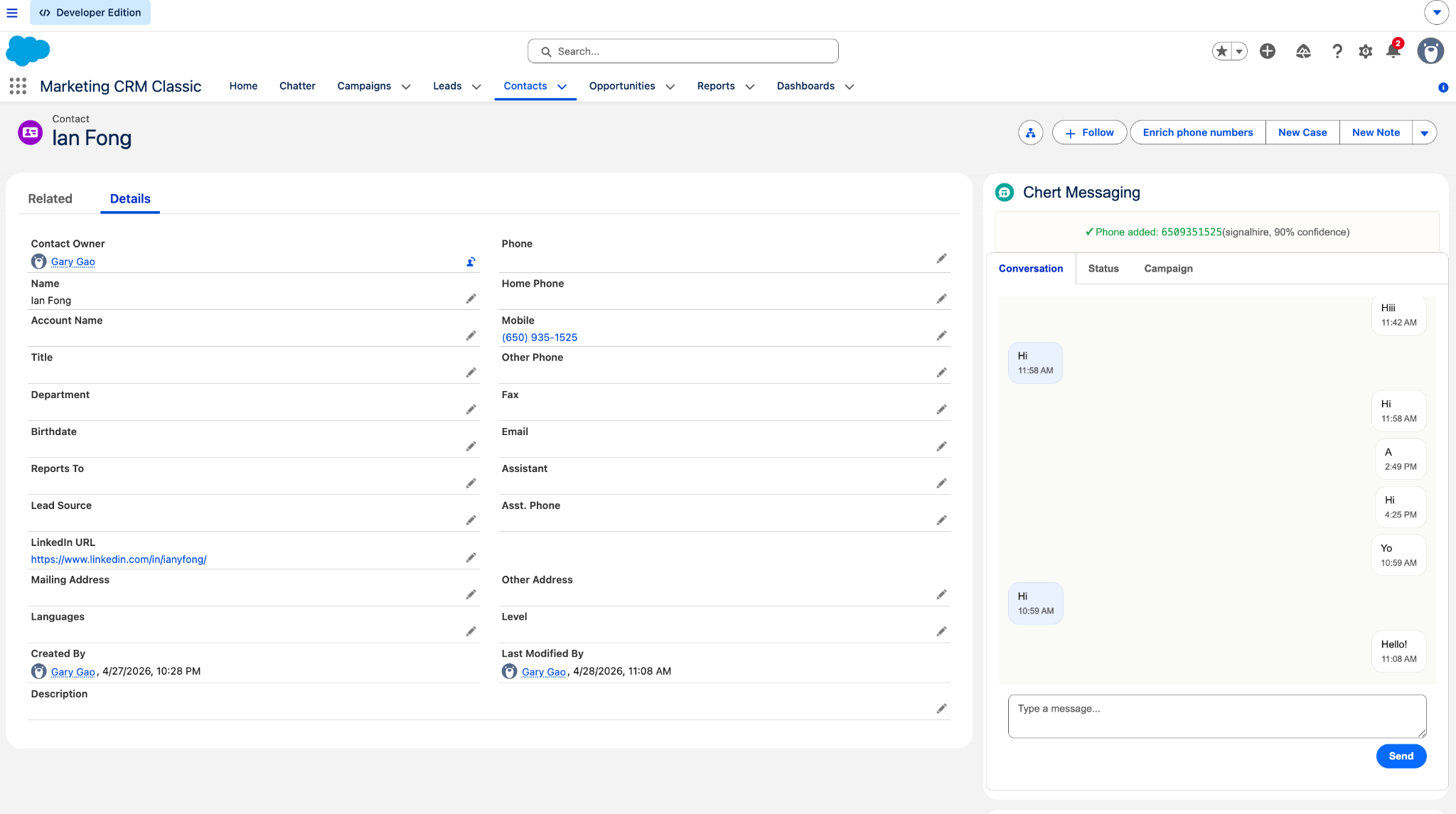
Verify: Open any Lead, Contact, or Account record. The Chert Messaging component appears in the right-rail with three tabs: Conversation, Status, and Campaign.
Salesforce Contact record page with the Chert Messaging widget visible in the right rail
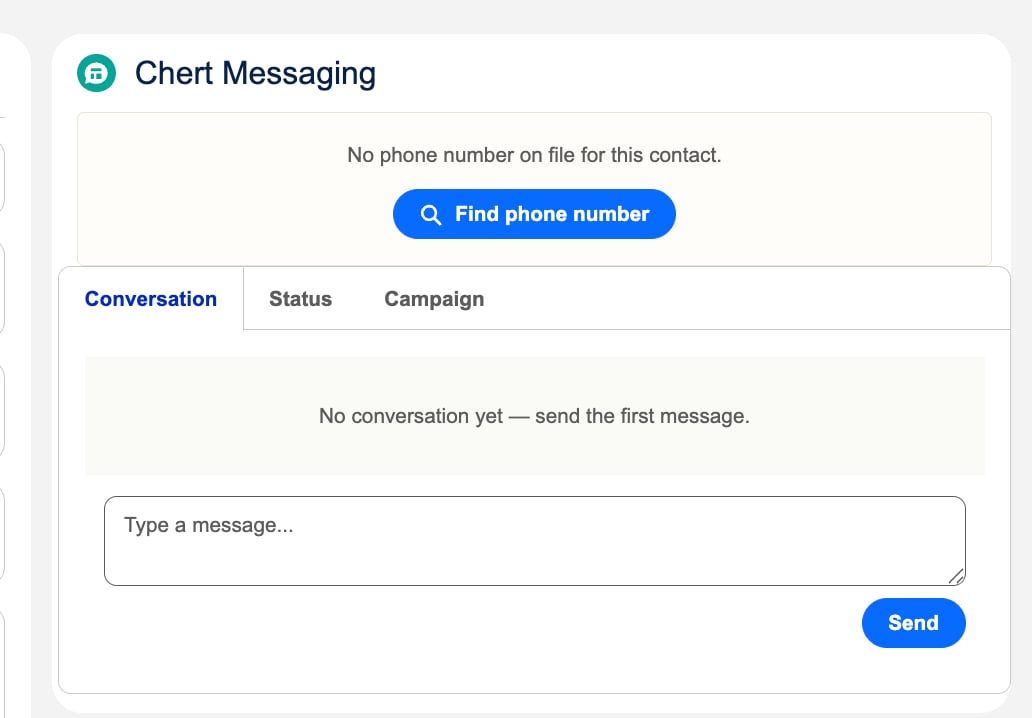
If the Contact has no phone number on file, the same component renders its empty state with a Find phone number action that triggers the enrichment pipeline:
The Chert Messaging widget showing the Find phone number action
Activation is per-environment. A sandbox-active page does not auto-activate in production. Repeat this step on each Org you deploy to.
If your Org already has a customized Lead/Contact record page, you can skip the shipped Flexipages and instead drop the chertConversation LWC component directly onto your existing page from Lightning App Builder. The component is exposed under the Custom — Managed section of the components palette.
4

Add Quick Actions to Contact list views

Two Quick Actions ship with the package and need to be exposed on Contact list views so reps can run them in bulk.
Quick ActionComponentPurpose
Enrich_Phone_NumberschertBulkEnrichBulk-enrich missing mobile numbers across selected Contacts
Start_Chert_SequencechertSequenceLauncherEnroll selected Contacts into a Chert sequence
To expose them on the Contact list view:
  1. From Setup → Object ManagerContactSearch Layouts for Salesforce Classic (or List View Button Layout in Lightning).
  2. Edit the List View layout.
  3. Add Enrich Phone Numbers and Start Chert Sequence to the Selected Buttons list.
  4. Save.
Verify: Open the Contacts tab in Lightning Experience, switch to any list view with selectable rows, select a few Contacts, and confirm both Quick Action buttons appear in the action bar.
Checkpoint — you should now be able to:
  • Open any Lead, Contact, or Account record and see the three-tab Chert Messaging component
  • Open the Contacts list view, select rows, and see the Enrich Phone Numbers + Start Chert Sequence buttons
  • See Chert_Message__c and Chert_Tenant__mdt in Object Manager
  • Find Chert Messaging User under Permission Sets
If any of those are missing, fix before moving to step 5. Step 5 sends real network traffic to Chert and assumes the package is fully installed and assigned.
5

Configure the Chert_Tenant.Default Custom Metadata record

This step pastes the credentials Chert provisioned for your Org into the package’s tenant configuration. Most customers do this on a 30-minute pairing call with Chert; the call confirms credentials are correct before any traffic flows.
  1. From Setup, enter Custom Metadata Types.
  2. Click Manage Records next to Chert Tenant.
  3. Edit the Default record.
  4. Paste these values from your Chert onboarding handoff:
    • Tenant_Slug__c — your Org’s identifier with Chert
    • Signing_Secret__c — HMAC-SHA256 key for outbound requests
    • Ingest_Token__c — bearer token Chert presents on inbound webhooks
    • Chert_Base_URL__c — leave default unless directed to a regional deployment
  5. Click Save.
Verify — three options, pick whichever you have access to:
  1. From the App Launcher (waffle icon, top-left), search for Developer Console. It opens in a popup window.
  2. In the popup, click DebugOpen Execute Anonymous Window.
  3. Paste this Apex snippet, replacing the placeholder Lead ID with a real Lead from your Org:
ChertSendIMessage.SendInput in = new ChertSendIMessage.SendInput();
in.phone = '+15555550123';
in.message = 'Test from anonymous Apex';
in.recordId = '00Q...your-test-Lead-id';
List<ChertSendIMessage.SendOutput> out =
    ChertSendIMessage.send(new List<ChertSendIMessage.SendInput>{ in });
System.debug(JSON.serializePretty(out[0]));
  1. Check the Open Log box, then click Execute.
  2. In the resulting log, search for USER_DEBUG. You should see:
USER_DEBUG|[7]|DEBUG|{
  "ok" : true,
  "messageId" : "msg_...",
  "duplicate" : false,
  "errorCode" : null,
  "errorMessage" : null
}
  1. Save the snippet above as scripts/apex/ping-chert.apex.
  2. From the command palette: SFDX: Execute Anonymous Apex with Editor Contents.
  3. Output appears in the VS Code Output panel under the Apex channel.
echo 'ChertSendIMessage.SendInput in = new ChertSendIMessage.SendInput();
in.phone = "+15555550123";
in.message = "Test from anonymous Apex";
in.recordId = "00Q...your-test-Lead-id";
System.debug(JSON.serializePretty(
  ChertSendIMessage.send(new List<ChertSendIMessage.SendInput>{ in })
));' | sf apex run --target-org <username>
What success looks like: ok: true, a non-null messageId, and an actual iMessage delivered to the recipient device within ~2 seconds.Common failures:
OutputCauseFix
errorCode: signature_invalidSigning_Secret__c does not match what Chert provisionedRe-paste the secret. Check for trailing whitespace/newline.
errorCode: tenant_not_foundTenant_Slug__c does not matchRe-paste the slug.
errorCode: phone_invalidphone not in E.164 formatUse +1 prefix and digits only, no spaces or dashes.
errorCode: all_servers_at_capacityChert side has no free phone-line slot for this recipient right nowNot a config problem; retry in a few minutes or contact Chert.
Treat Signing_Secret__c and Ingest_Token__c as production secrets. Do not export them via the Metadata API to non-System Administrators. The Custom Metadata record’s Protected Component flag should be set to true before any 2GP managed-package promotion.
6

Connect the Slack channel for reply notifications

Chert handles this step. During the pairing call in step 5, Chert will:
  1. Install the Chert Notifications Slack app into your workspace.
  2. Bind the app to the channel you nominate (typically #chert-replies or a channel scoped to the team that owns outbound).
  3. Configure the per-channel feature flags (daily summary canvas, low-leads alert, settings mirror).
Customer-side action: have a workspace admin available to authorize the Slack OAuth install when Chert sends the install link. ~2 minutes of admin time.Verify: Once bound, ask Chert to fire a test reply notification. The card should appear in the bound channel with a conversation preview, an AI-drafted suggested reply, and a Review & reply → deep-link to the Chert console.See Slack notifications for the full card anatomy and the thread-reply triage flow.
7

(Optional) Wire a Flow handoff from your existing email sequencer

If your team already runs email outreach in Outreach, Salesloft, or a Salesforce-native sequencer and wants iMessage to fire as a follow-up step, this is one Flow plus one invocable action.
  1. From Setup, enter FlowNew FlowRecord-Triggered Flow.
  2. Object: Lead (or Contact, or your sequencer’s enrollment object).
  3. Trigger: A record is updated.
  4. Entry condition: whatever your sequencer sets to mark a step as complete and ready to hand off (e.g., Outreach_Step__c = 'iMessage').
  5. Add an Action element. Search for Chert Send iMessage.
  6. Bind:
    • phone{!$Record.MobilePhone} (or Phone)
    • message → a text template, e.g., Hey {!$Record.FirstName}, following up on the email I sent.
    • recordId{!$Record.Id}
    • idempotencyKey{!$Record.Id}:imessage:1 (deterministic; replays are no-ops)
  7. Add a Decision branch on the action’s duplicate output:
    • duplicate = true → log success but don’t re-send
    • ok = false → write the error to a custom field for retry
  8. Save and activate the Flow.
Verify: Trigger the entry condition manually on one test record. Within ~1 second the Flow runs; within ~2 seconds the recipient sees the iMessage; within a few seconds the Chert_Message__c row plus a standard Task appear on the record’s Activity Timeline.

Verify the Installation End-to-End

Once all seven steps are complete:
  1. Open any Lead with a valid mobile number.
  2. Open the Chert Messaging component → Conversation tab.
  3. Type a test message and click Send. The bubble should appear with a status indicator.
  4. From Setup → Apex Jobs, confirm no failed ChertEnrich jobs.
  5. From Setup → Setup Audit Trail, search for Chert_ to confirm the install + configuration entries.
  6. Reply from the recipient device. Within a few seconds, the inbound bubble appears in the Conversation tab and a Chert_Message__c row + a standard Task are inserted on the Lead.

Troubleshoot

The package does not perform mixed DML on its own. Investigate your Org’s test data factory or any triggers that fire during package test execution.
The Lightning Record Page is not active for the user’s profile, app, or record type. From Lightning App Builder, open the page, click Activation, and confirm the scope covers the user trying to view the record.
The running user does not have the Chert Messaging User Permission Set, or the Permission Set is missing Apex class access to ChertSendIMessage. Re-assign in step 2.
The Chert_Endpoint Named Credential URL was overwritten. Reset to https://console.trychert.com/api/salesforce/v1 from Setup → Named CredentialsChert Endpoint.
The Signing_Secret__c in your Chert_Tenant.Default record does not match what Chert provisioned. Re-paste from the secure handoff and confirm there is no trailing whitespace or newline.
Either the Ingest_Token__c is wrong (Chert can’t authenticate to the ingestion REST endpoint) or your Org’s network rules block inbound HTTPS from Chert’s webhook range. Ask Chert to replay the most recent event from console.trychert.com → Events → Replay. If the replay 401s, fix the token; if it 500s with a network error, contact your network admin.

Upgrade from a Previous Version

Re-run sf project deploy start against the same target Org with the new source tree. Custom Metadata records, Permission Set assignments, and Lightning Record Page activations are preserved. Active Flows referencing ChertSendIMessage continue to work as long as the action’s input contract is unchanged. Coordinate breaking changes per version with Chert.

What’s next

Once the seven steps are complete and the end-to-end test in Verify the Installation End-to-End passes, you’re live. Next:

Run the tutorial

Hands-on walkthrough: open a Lead, send a real iMessage, observe the round-trip.

Review the configuration

Per-component reference for Permission Set scope, Custom Metadata fields, and Quick Action behavior.

Plan a pilot

Coordinate with Chert on the first sequence template, send window, and phone-line allocation.

Read the security model

Trust boundary, HMAC format, and sharing posture per Apex class. Share with your security review team.

See Also